


Grey Cup Odds 2026: A Bettor’s Guide to Winning Wagers
Montreal are the current favourites, but the 2026 board isn't wide open in the way casual bettors often assume. It's compressed at the top, with Montreal at 4.00, BC at 5.00, and Saskatchewan at 7.00, which means the best value may sit just behind the favourite rather than on it.
That's what makes grey cup odds worth studying right now. This isn't a market with one runaway team and a field of outsiders. It's a market asking you to price a cluster of contenders, then decide whether the number on the screen matches the team's real path to November.
Your Guide to the 2026 Grey Cup Betting Market
The first thing to know is simple. Being the favourite doesn't automatically make Montreal the best bet. In a tight futures market, price matters more than name value.
The current 2026 Grey Cup board shows exactly that. Montreal leads, but BC and Saskatchewan sit close enough that one strong stretch, one injury return, or one ugly month from the favourite can shift the whole market. That's the core betting angle here. You're not just trying to guess who wins. You're trying to spot when the odds understate a real contender's chances.
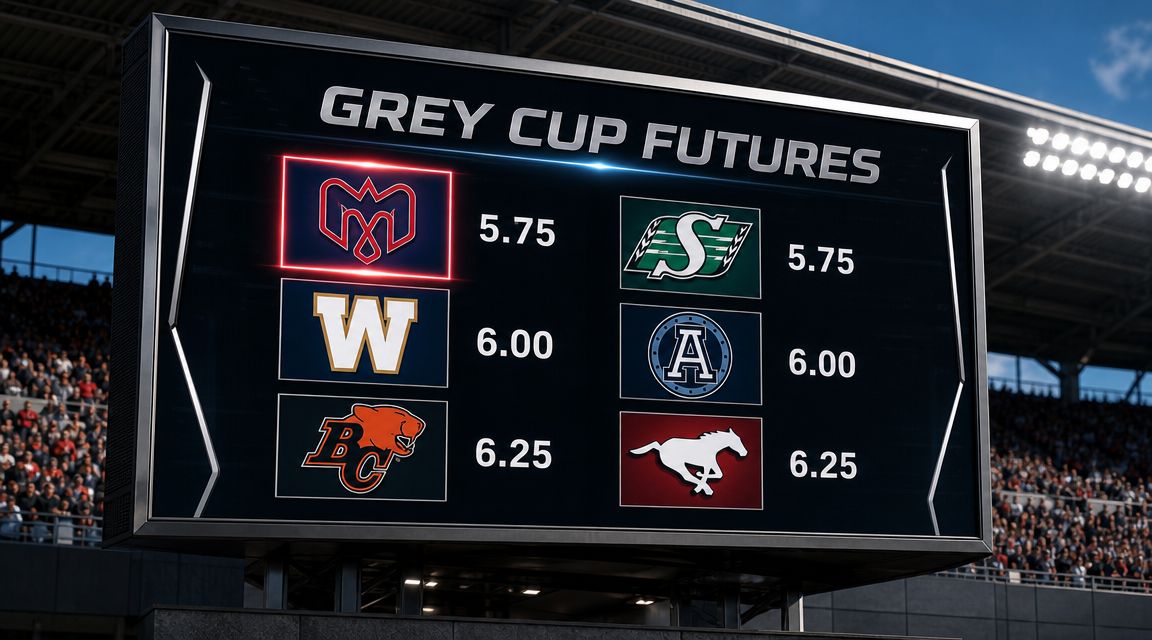
A good futures bettor reads the board in layers:
Top-end compression: Montreal, BC, and Saskatchewan are priced close enough that the market doesn't see a dominant team.
Recency bias: Saskatchewan's 2025 Grey Cup win over Montreal matters because bettors and traders react fast to a title run.
Timing edge: In a clustered market, when you bet can matter almost as much as who you bet.
A short price tells you the market respects a team. It doesn't tell you the price is good.
One practical example makes the point. Saskatchewan beat Montreal 25-17 in the 2025 Grey Cup and ended a championship drought of more than 10 years, as noted on this Grey Cup odds market snapshot. That result helps explain why the Roughriders opened the next market as a serious contender rather than a longshot.
If you want to bet this board well, don't start with loyalty. Start with probability, price, and patience.
How to Read Grey Cup Odds Like a Pro
Most bettors look at grey cup odds and see payout first. Sharp bettors see probability first.
The three formats you'll run into
You'll mostly see decimal odds in this article because they're clean and easy to compare. But if you follow CFL markets across different books and content pages, you'll still run into American and fractional formats.
Here's the same idea shown three ways.
| Format | Example Odds | Implied Probability | Total Payout on $10 Bet |
|---|---|---|---|
| Decimal | 4.00 | 25.0% | $40.00 |
| American | +300 | 25.0% | $40.00 |
| Fractional | 3/1 | 25.0% | $40.00 |
A $10 bet at 4.00 returns $40.00 total if it wins. That includes your original stake. The same is true at +300 or 3/1.
If you track more week-to-week movement in Canadian football markets, the latest CFL odds coverage is a useful way to keep the terminology familiar.
Implied probability is the real language of betting
Odds are just another way of saying what the market thinks a team's chance is.
Implied probability is the percentage chance the odds assign to an outcome.
With decimal odds, the quick calculation is 1 ÷ decimal odds.
So:
4.00 implies 25.0%
5.00 implies 20.0%
7.00 implies about 14.3%
That matters because it changes how you read a board. A team at 4.00 isn't “likely” to win. The market is effectively saying that team wins about one time in four before margin.
Why casual bettors misread futures
A common mistake is to focus only on the biggest possible return. That's how bettors end up backing prices they haven't really evaluated.
Use this quick filter instead:
Translate the odds into a percentage
Ask whether that percentage feels too high or too low
Compare that answer across multiple teams, not just your favourite
Practical rule: If you can't state the team's implied chance in plain language, you probably don't understand the bet well enough yet.
A second mistake is treating futures and game lines as the same thing. They're not. Futures reflect an entire season path, roster durability, and playoff route. Single-game odds react to one matchup, one venue, and one injury report.
A simple way to think like an analyst
When you see Montreal at 4.00, don't ask, “Can they win?” Of course they can.
Ask this instead:
Does 25.0% feel fair?
Is another contender priced as if it has less chance than it really does?
If the market is bunched, would waiting for a better number make more sense than betting now?
That shift sounds small. It isn't. It's the difference between betting teams and betting prices.
Analyzing the 2026 Grey Cup Favourites
The top of the 2026 Grey Cup board is tighter than casual bettors usually assume. Current market data places Montreal at 4.00, BC at 5.00, and Saskatchewan at 7.00. That pricing matters because it points to a crowded title race, not a runaway favourite with clear separation from the field.
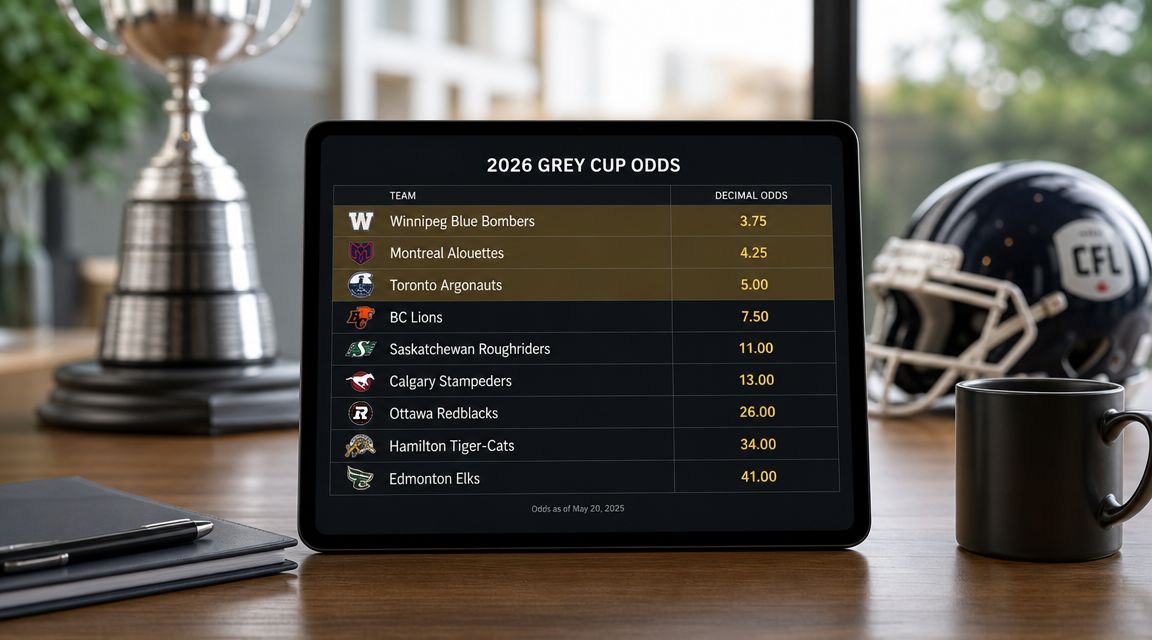
Montreal deserves favourite status
Montreal at 4.00 fits a team with sustained recent relevance and a profile the market already trusts. The key betting question is not whether the Alouettes belong near the top. It is whether their true title chances are meaningfully higher than the price implies.
That distinction matters in futures. A strong team can still be a weak bet if the number already bakes in most of the upside.
Montreal's position also says something broader about the market. Traders are rewarding continuity and proven postseason equity, which usually keeps a contender short before the season gives bettors more information.
BC has the cleanest case to challenge the favourite
BC at 5.00 is where the board gets more interesting for value-minded bettors. The raw difference from Montreal looks modest, but the pricing gap is large enough to force a sharper question. Is BC only a small step behind the favourite, or is the market still charging a premium for Montreal's recent track record?
That is often where futures value appears. Small changes in decimal odds create meaningful changes in expected return, especially in a top tier where the teams are relatively close in quality.
For bettors who want to connect futures pricing with shorter-term team evaluation, this week's CFL picks coverage offers a useful read on weekly form and matchup signals.
Saskatchewan carries respect, but also uncertainty
Saskatchewan at 7.00 sits in a different part of the conversation. The Riders have championship credibility after the 2025 title, yet the market is still leaving room for volatility. That usually reflects a mix of respect for the roster and caution about repeating a championship path over another full season.
Defending champions often attract public money early. If that support fades or the team shows any softness, the number can move back into a more attractive range.
That makes Saskatchewan less of an automatic buy and more of a team to track closely. Timing matters as much as opinion with this kind of futures ticket.
What the top tier actually tells you
The main takeaway is strategic. Montreal has the strongest market case, BC may offer the cleaner pricing argument, and Saskatchewan looks like the team most likely to create a better entry point if sentiment shifts.
A smart bettor should treat these three prices as competing probability statements, not just a ranking of good teams. That is the difference between reading the board and finding value on it.
Finding Value and Spotting Market Differences
The Grey Cup futures board is not a single consensus. It is a collection of prices, and the gaps between those prices are often more useful than the team rankings themselves.
That matters because value in this market usually comes from disagreement, not from spotting a team everyone already likes. If your handicap makes a club more likely to win than the odds imply, you may have a bet. If another book prices that same club shorter, you also have proof that the market is not settled.
Why market differences matter in futures
A small price edge carries more weight in a season-long bet because your money is tied up for months and the hold is usually higher than it is on a weekly game. A bettor who takes the first available number gives away one of the few advantages still available in a mature market.
The practical question is simple. What probability is the book asking you to accept, and is that number too high or too low?
A longer price gives you more margin for error. A shorter one demands near-perfect timing.
How to test whether a Grey Cup number has value
Use a three-part screen:
Start with implied probability. Convert the odds into a percentage and compare that figure to your own estimate.
Check the team's neighborhood on the board. A price only makes sense relative to the teams around it, not relative to preseason headlines.
Compare across the market. If one book hangs a meaningfully better number, the difference is not cosmetic. It changes the expected return.
That last point is where disciplined bettors separate themselves. In futures, being right on the team but wrong on the price can still produce a poor bet.
Betting rule: Back the number, not the logo.
Where bettors usually give away edge
Public money tends to chase what just happened. That can shorten a popular team before the price properly reflects long-term risk, especially after a playoff run or a hot start. The better entry point often comes later, when attention shifts and the market cools.
A sharper process looks like this:
Assign your own win probability to the realistic contenders.
Mark the price where each team becomes playable.
Wait unless the market gives you that number.
That approach sounds basic, but it forces discipline. In a compressed Grey Cup market, patience and price sensitivity matter as much as your football read.
Lessons from Grey Cup Betting History
Grey Cup futures teach one lesson over and over. Recency gets priced fast.
Saskatchewan is the best recent example. The Roughriders beat Montreal 25-17 in the 2025 Grey Cup and ended a title drought of more than 10 years. By the next preseason cycle, they were no longer treated like an outsider. They were priced as a prominent contender. That shift is useful because it shows how quickly the market folds recent success into the next board.
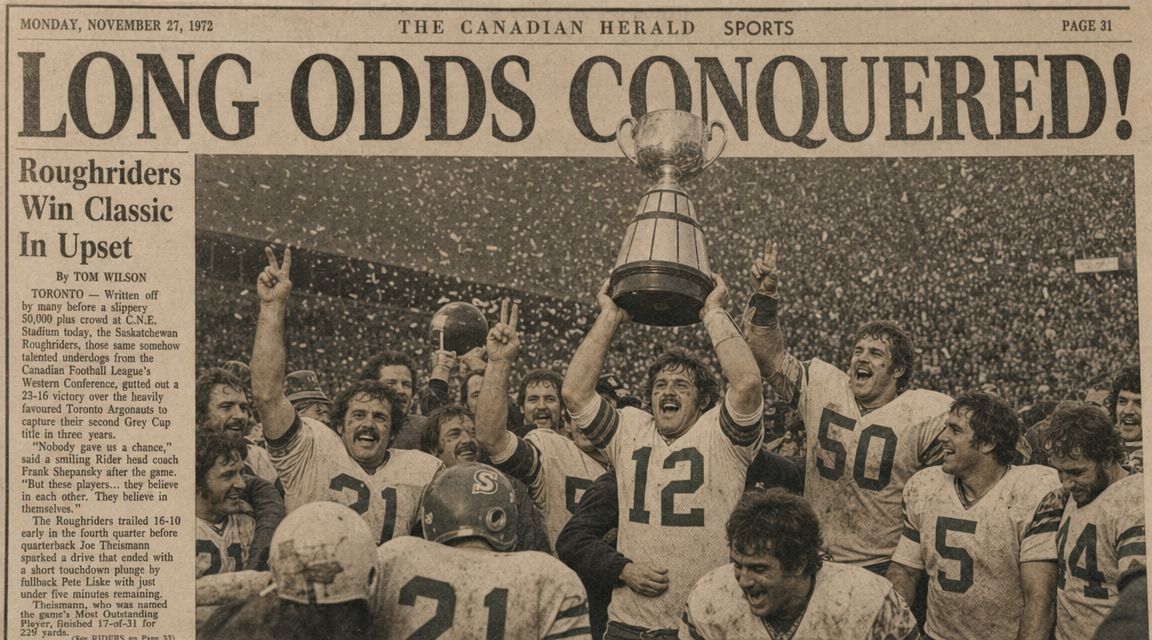
Futures history isn't about nostalgia
What matters isn't that a champion won. It's how the market reacted after.
In one preseason snapshot, Montreal appeared at +165 while Saskatchewan was shown at -200. In another board, Montreal was +260, Saskatchewan +400, BC +500, Toronto +550, and Winnipeg +950. Those gaps implied very different views of the same season, including examples such as +165 translating to about 37.7% and -200 to 66.7% on the same source page. That's the lesson. Historical context matters, but price disagreement matters more.
What history tells you to do now
Don't read long odds as “no chance.” Read them as “the market is unconvinced.”
A futures board is just a set of opinions with margin attached. Some of those opinions are sharper than others. Some are just reacting to the last thing everyone watched.
When a team lifts the Cup, the next market often prices the memory before it prices the new season.
That doesn't mean you should fade every recent champion. It means you should ask a harder question. Is the team strong, or is the number inflated because bettors remember the final score?
The smarter historical takeaway
The best futures bets usually come from resisting the obvious story.
When a team wins the Grey Cup, public attention follows. That often squeezes the number. If the board then cools over time, that's when a bettor can find a cleaner entry point. History doesn't hand you the winner. It shows you when the market is most likely to overreact.
Smarter Betting and Your Next Steps
Grey Cup bettors lose value when they treat every market as the same problem.
A futures bet asks whether a team can survive months of variance, injuries, and playoff seeding. The championship-game market asks a tighter question. What is this matchup worth today, at this number, under this scoring expectation? If you blur those two markets together, you usually pay for certainty twice.
That distinction matters because a good preseason ticket does not automatically create a good Grey Cup game bet. A team can be correctly priced as a futures contender, then overpriced in the final once the market adjusts for venue, health, weather, and matchup specifics. The sharper move is to price each decision on its own terms.
Futures versus game-day markets
Use a simple framework:
Futures odds: Your edge comes from being earlier than the market on a team's true title chance.
Moneyline or spread: Your edge comes from rating one opponent against another in a single game.
Total: Your edge comes from spotting a difference between the expected pace, efficiency, and game script and the number on the board.
Here is the practical implication. If you hold a long-priced futures ticket that reaches the Grey Cup, you do not need to force a side bet just because you made the final. Sometimes the best value is on the total. Sometimes it is on the other team if the public pushes the matchup too far. Sometimes the right decision is no new bet at all.
A sharper betting plan
The process is straightforward, but it has to be disciplined.
Set a buy price before the market moves: If you would only bet a contender at a certain number, wait for that number or pass.
Translate odds into implied probability: A number means little until you ask what chance it assigns and whether your own estimate is higher.
Shop for differences across the board: Small pricing gaps matter more in futures because the hold is usually higher.
Stake futures smaller than single-game bets: Your money is tied up longer, and more can go wrong before you ever reach the final.
Reassess once the matchup is set: Do not let an old preseason opinion override new information.
If your futures position improves and you need to protect equity, this guide on how to hedge your bets gives you a clear framework.
The market does not reward being early. It rewards being early at the right price.
That is the takeaway many bettors miss. Picking a strong team is not enough. You need a number that leaves room for error, because error is built into every CFL season.
The risk control that matters
Set your bankroll rules before opening day. Keep futures exposure limited, avoid chasing a bigger payout after line movement, and do not treat Grey Cup week as a rescue mission for bad earlier bets.
The useful next step is specific. Build a short list of contenders, assign each a rough title probability, convert the available odds into implied probability, and wait for a gap. That is where value usually appears. Not in the loudest team story, but in the price the market gets slightly wrong.